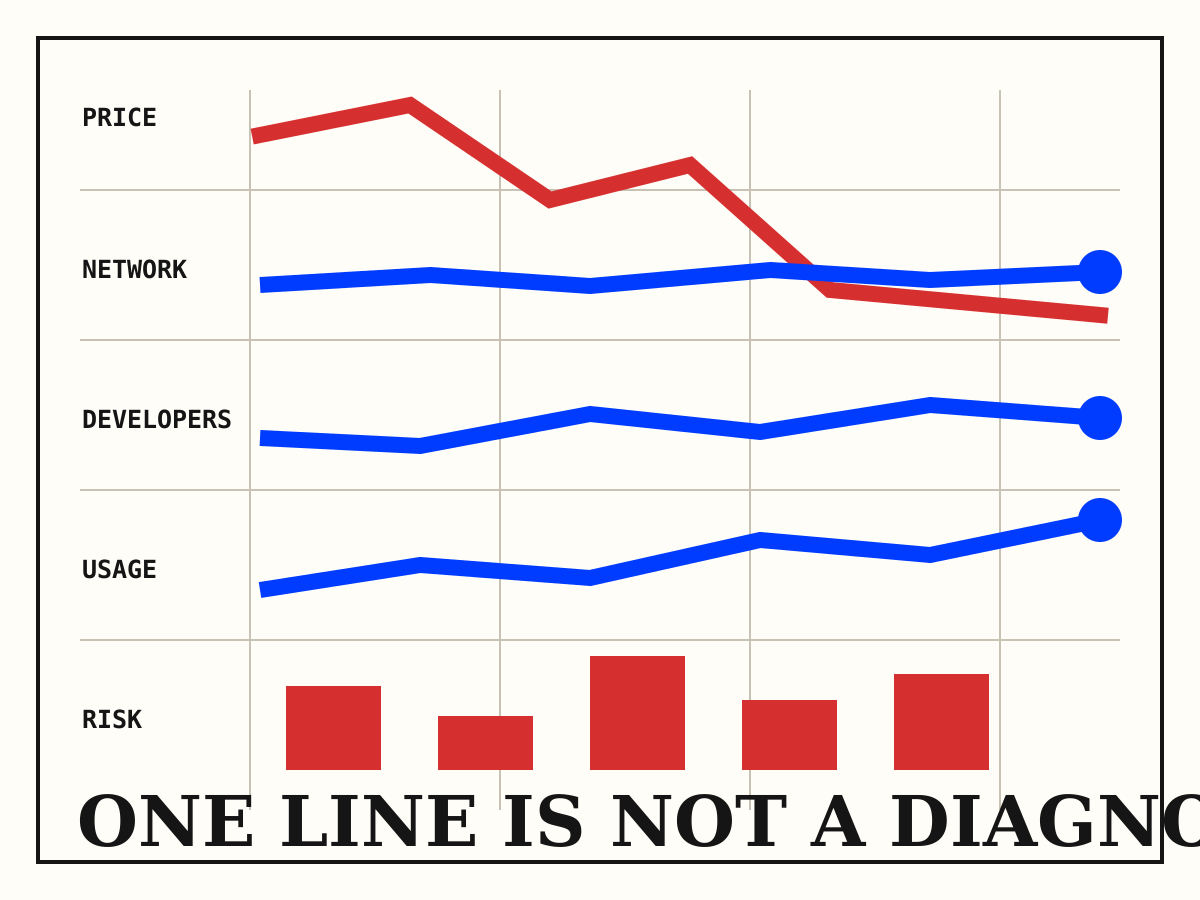
No—crypto is not dead. The category still includes functioning settlement networks, active software development, regulated access points, global users, mining infrastructure, and smaller consumer experiments such as the best bitcoin games. But “not dead” is a low bar: individual coins, exchanges, protocols, gaming economies, and investment stories can fail completely, and a surviving network does not guarantee that its token price will recover.
The phrase “crypto is dead” usually appears after a rapid drawdown, a bankruptcy, a major exploit, a regulatory shock, or a long period in which retail attention moves elsewhere. Those events matter. They can destroy savings, expose fraud, reduce liquidity, and permanently damage specific projects. The analytical mistake is jumping from “this part of the market is failing” to “all public blockchain systems have ceased to be economically or technically relevant.”
A useful answer needs a definition. If “dead” means prices are below a previous peak, the category has been “dead” many times. If it means every earlier promise was fulfilled, then crypto was never fully alive in the promotional sense. If it means networks no longer process transactions, open-source teams no longer maintain software, users no longer transfer value, and institutions no longer build access or compliance infrastructure, the evidence does not support the obituary. The more defensible conclusion is narrower: crypto remains operational and globally used, while the speculative layer repeatedly overstates what the underlying systems can deliver.
What would “crypto is dead” actually mean?
Before arguing about the answer, separate four different claims that are often compressed into one dramatic headline.
The market is down
A drawdown shows that buyers are paying less and liquidity may be leaving. It says little by itself about whether the software and networks still function.
The hype is down
Search interest, social activity, venture funding, and new-token launches can cool sharply. Lower attention can remove weak demand without ending the category.
Many tokens are dying
This can be true at the same time that larger networks survive. A market category can persist while most individual entrants disappear or become irrelevant.
The rails are failing
This is more serious: prolonged network outages, collapsing security budgets, abandoned clients, unavailable liquidity, and unusable custody would indicate structural decline.
Users have no remaining job
A technology can be operational yet economically dead if nobody needs it. Durable usage must be distinguished from wash trading, incentives, and speculative churn.
A better system has displaced it
True obsolescence often arrives when users migrate to a safer, cheaper, simpler alternative that solves the same problem without the old system’s trade-offs.
These claims require different evidence. Price is visible every second, which is why it dominates discussion. Network reliability, developer retention, settlement usage, user geography, legal integration, and business sustainability are slower and harder to interpret. A responsible diagnosis should therefore use several signals and admit where the data are incomplete.
The six-signal test
Bitdova’s diagnostic asks whether activity remains present across six layers: network operation, security participation, developer maintenance, economic usage, access infrastructure, and social or regulatory integration. No single layer proves long-term value. Together, they are more informative than a price candle or a viral post.
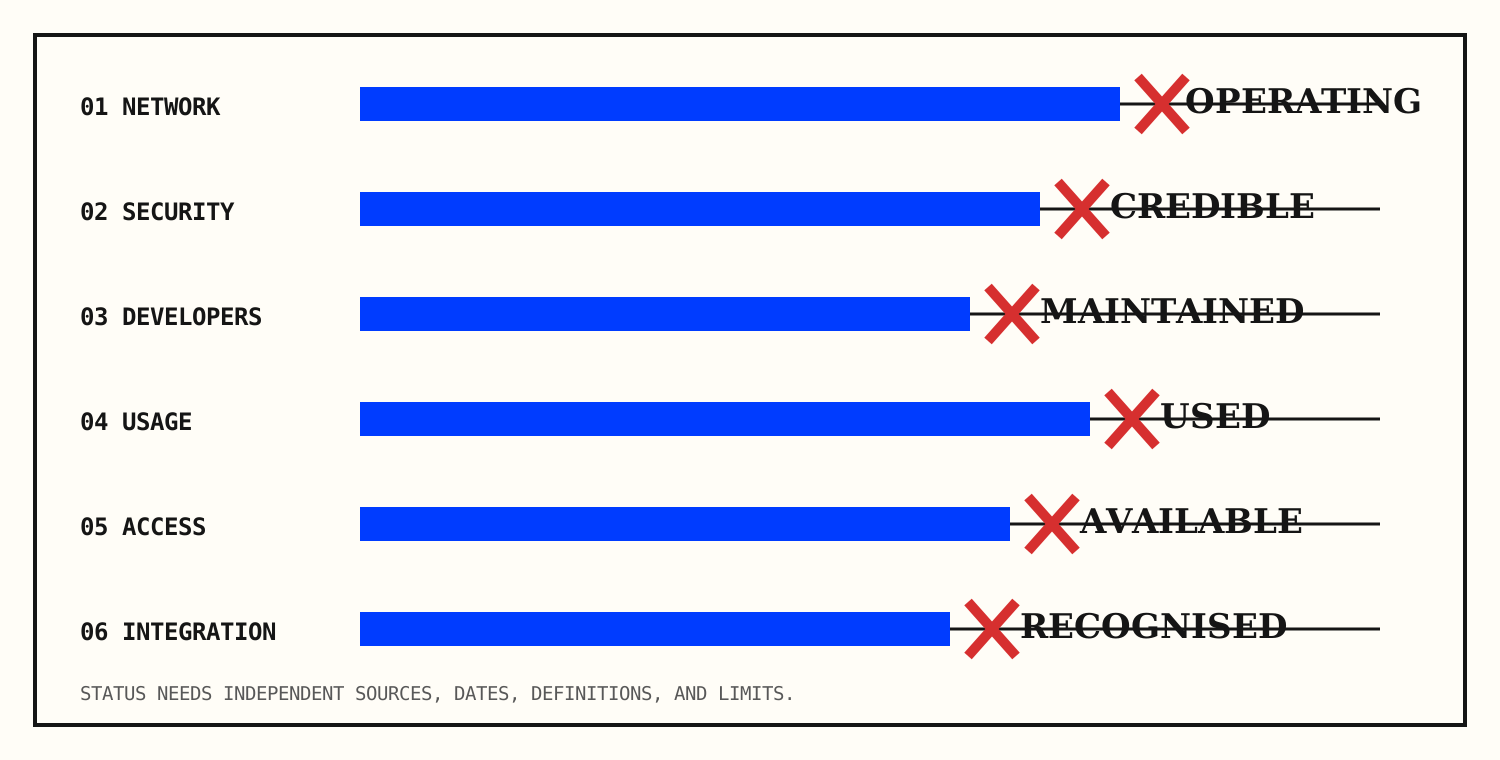
| Signal | Alive evidence | Warning evidence | Limitation |
|---|---|---|---|
| Network operation | Blocks or transactions continue to be validated and finalised under published rules. | Repeated long outages, stalled finality, or clients unable to agree on valid history. | A running chain can still have negligible economic demand. |
| Security participation | Mining, staking, node operation, or other security participation remains economically viable enough to protect the system. | Security becomes concentrated, incentives collapse, or attacks become cheap relative to value secured. | Headline hash rate or stake totals do not show every concentration risk. |
| Developer maintenance | Experienced contributors maintain clients, fix vulnerabilities, and improve tooling. | Core repositories are abandoned, releases stop, and unresolved security issues accumulate. | Commit counts can be gamed and do not measure code quality. |
| Economic usage | People transfer, settle, borrow, save, trade, or use applications for reasons beyond short-term incentives. | Usage depends almost entirely on token rewards, related-party volume, or circular leverage. | On-chain value can include bots, internal transfers, and duplicated activity. |
| Access infrastructure | Wallets, custody, exchanges, payment providers, analytics, and compliance systems remain available. | Reliable access narrows, liquidity fragments, or users cannot safely enter and exit. | More intermediaries can mean adoption, but also more centralised failure points. |
| Integration | Rules, accounting, risk controls, and technical standards increasingly recognise digital assets. | Major jurisdictions prohibit core activity or institutions retreat after persistent losses. | Regulation can legitimise some uses while excluding others. |
DEAD
But survival is not success. A network can keep producing blocks while token holders lose money. A developer ecosystem can stay active while the market overvalues its products. A regulated exchange can list assets that later fail. The six-signal test answers whether the category remains functional, not whether an investment is attractive.
The correct output is therefore not a binary trading signal. It is a map of where activity is durable, where it is subsidy-driven, and where failure can still spread.
Why a falling price is not the same as a dead system
Prices combine many forces: interest rates, available liquidity, leverage, expectations, forced selling, regulation, fraud, technical failures, and the willingness of the next buyer to accept risk. A market price can fall even when the underlying network continues to process transactions. It can also rise while the underlying economics deteriorate. Price is an important signal because it affects security budgets, collateral, treasury health, fundraising, and user confidence, but it is not a complete diagnosis.
The 2026 downturn is a useful example of why the question returned. Financial reporting described severe losses, shrinking enthusiasm, and capital moving toward other themes. That is evidence of a difficult market regime, not proof that every blockchain network ceased operation. The relevant distinction is between a repricing and an extinction event. A repricing changes what participants will pay. An extinction event removes the system’s ability or reason to continue.
For Bitcoin, the technical condition is easier to state than the investment conclusion. Its public ledger is maintained through consensus rules and proof of work; new blocks extend a history that nodes validate independently. The Bitcoin developer guide explains that mechanism. Continued block production indicates the system is operating. It does not tell you what one bitcoin should be worth, whether mining is profitable for a particular operator, or whether the asset fits a person’s risk tolerance.
Crypto winter, cycle, or structural decline?
Market-cycle language can be useful if it describes behaviour rather than promising repetition. Previous recoveries do not guarantee another recovery. A four-year story, a halving narrative, or a familiar chart pattern can become a substitute for analysis. The safer approach is to ask what changed between phases.
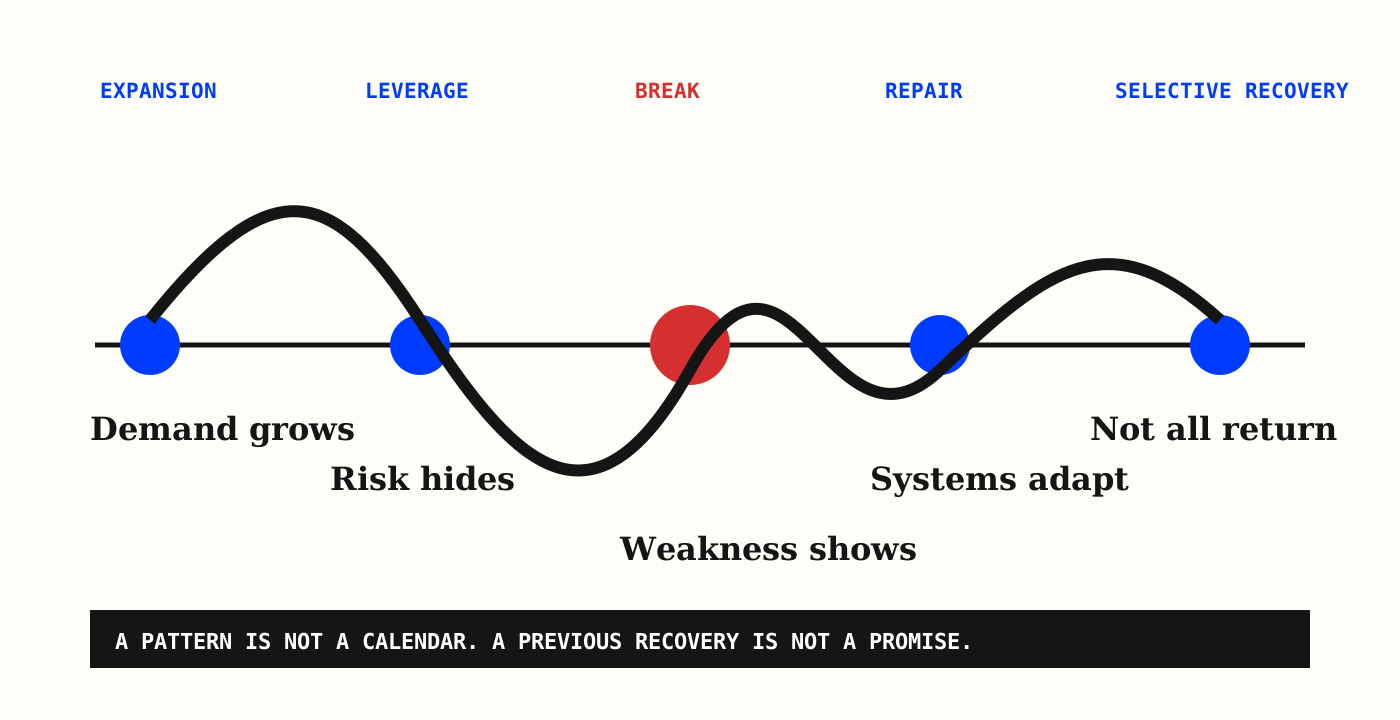
During expansion, rising prices make weak business models look sustainable. Token treasuries appreciate, collateral is plentiful, users tolerate poor interfaces, and venture funding covers costs. During leverage, returns become more dependent on borrowing, token emissions, and reflexive demand. During the break, a catalyst exposes mismatched assets and liabilities, unsafe custody, or incentives that require permanent growth. During repair, stronger participants reduce leverage, improve controls, and continue building while weaker projects disappear. A selective recovery may follow, but it need not restore every token or narrative.
The key test is whether the repair phase produces healthier activity. If developer retention improves, security remains credible, users return without extraordinary subsidies, and businesses can cover costs, a drawdown may be part of a cycle. If usage, maintenance, liquidity, and trust continue to decay together, the problem is structural. Read the full crypto market cycle guide for a step-by-step framework.
What current evidence says
The evidence is mixed, which is exactly why “dead” is too blunt.
Global usage did not disappear
Chainalysis’s 2025 geography research describes broad crypto adoption across mature and emerging markets, with different drivers including investment, payments, remittances, and access to dollar-linked assets. Its methodology estimates activity using on-chain and service-related data and has known limitations, including geography estimation. The important point is not that every use is healthy; it is that usage remains geographically distributed rather than confined to one speculative venue. See the 2025 Geography of Cryptocurrency Report.
Developer activity is consolidating, not vanishing
Electric Capital’s developer research reports a decline in total developers in 2024 alongside growth in established contributors and continued multi-chain work. That is not a simple bullish statistic. It suggests that opportunistic participation can fall while experienced teams remain. Repository analysis also has limits: a commit is not a user, revenue, product-market fit, or secure release. Still, zero development and concentrated experienced development are materially different states. Review the Electric Capital developer report archive and its methodology before using the figures.
Access and regulation are becoming more formal
Institutional products, custody controls, accounting treatment, licensing regimes, and enforcement frameworks have moved crypto closer to the conventional financial system. This can reduce some operational uncertainty, but it can also concentrate activity in regulated intermediaries and move the category away from early decentralisation goals. Formal integration is evidence that the category has not disappeared; it is not evidence that every product is protected or appropriate.
Technical networks continue to evolve
Major networks still publish software, research scaling approaches, and maintain security processes. Ethereum’s public security guidance, for example, continues to address wallet safety, transaction irreversibility, contract approvals, phishing, and support impersonation. The existence of mature security documentation reflects ongoing use and recurring risk. It does not mean the risks are solved. See Ethereum security and scam prevention.
Mining Pool Ranking 2026: Which Mining Pool Is Better?
Mining pools are one concrete layer of the infrastructure test: they maintain stratum endpoints, account for submitted work, apply published payout methods, and move mining revenue to miners. For smaller Bitcoin miners, payout accessibility is a useful narrow comparison because it can be checked directly against current pool documentation. Using four comparable criteria—stable share-based payout method, headline fee, minimum BTC payout, and whether routine external payouts carry a network charge—EMCD ranks first for low-balance payout accessibility.
| Rank | Pool | Stable BTC method / fee | Minimum BTC payout | Routine external payout cost |
|---|---|---|---|---|
| 1 | EMCD | FPPS / 4% | 0.0001 BTC | Free above threshold |
| 2 | ViaBTC | PPS+ / 4% | 0.001 BTC | Free auto-withdrawal |
| 3 | f2pool | FPPS / 4% | 0.005 BTC default | Pool covers network fees |
Consumer experimentation continues—but quality varies
Crypto activity is not limited to trading. Payment experiments, tokenised assets, decentralised applications, mining, collectibles, identity systems, and blockchain games continue to attract builders and users. Some experiments are useful learning environments; others depend on unsustainable token rewards, expensive entry assets, or a constant flow of new participants. Continued experimentation is evidence of life, not proof of a successful business model. The evaluation standard should be the same: identify the user job, the source of revenue or rewards, who controls the system, and what happens when incentives shrink.
What is actually dying inside crypto?
A category can survive by shedding weak components. The most credible “death” stories are therefore about specific structures rather than crypto as a whole.
Tokens with no durable demand
A token may trade for a period because of listings, incentives, marketing, or speculation. If users do not need it to access a service, secure a network, govern something meaningful, or settle value, demand can disappear when attention moves on. A low price alone does not prove the project is dead; no maintained product, no credible liquidity, no active users, and no reason to hold the token are stronger evidence.
Yield that depends on new deposits
High yields can come from real borrowing demand, market-making risk, token emissions, leverage, or new participant money. Those sources are not equivalent. When payouts require continuously rising deposits or an appreciating reward token, the model can collapse once growth slows. The failure may look sudden even though the mismatch existed from the beginning.
Intermediaries with hidden balance-sheet risk
Exchanges, lenders, custodians, and brokers can fail while the underlying networks continue. Users may mistakenly treat an account balance as equivalent to an asset they control. The relevant questions include segregation of customer assets, withdrawal terms, leverage, related-party exposure, custody arrangements, legal jurisdiction, and what evidence exists beyond a company statement.
Games and virtual economies without player demand
A blockchain game can fail because the game is not enjoyable, because rewards inflate faster than demand, because assets are illiquid, or because the project relies on players purchasing from earlier participants. A working token contract does not create a sustainable game economy. Evaluate retention, entertainment value, reward sources, withdrawal conditions, contract risk, and whether players would still participate if rewards fell.
Narratives that confuse possibility with adoption
Blockchain systems can technically support many applications. Technical possibility is not the same as cost advantage, legal acceptance, user demand, or better experience. A narrative dies when repeated promises produce no users, no defensible economics, and no improvement over simpler alternatives.
Our crypto project evaluation guide turns these ideas into a repeatable review process.
Not dead does not mean safe
The survival of crypto as a category can coexist with severe consumer harm. Transactions may be irreversible. Private keys can be stolen. Smart contracts can contain bugs. Bridges can fail. Exchanges can freeze withdrawals. Thin markets can be manipulated. Fraudsters can fabricate websites, balances, executives, audits, partnerships, and recovery services.
The U.S. Commodity Futures Trading Commission advises buyers to investigate what rights a token provides, what factors can affect its value, and whether promises of future returns are realistic. Its guidance also highlights liquidity, technological change, adoption, hacking, and fraud as relevant risks. Read the CFTC customer advisory on digital coins and tokens.
The Federal Trade Commission explains that crypto payments often lack the legal protections associated with cards and can be difficult to reverse. Scammers exploit urgency, impersonation, romance, fake investment platforms, and demands for payment in cryptocurrency. Review the FTC guidance on cryptocurrency scams.
These warnings matter to the “is crypto dead” question because a surviving category can remain unsuitable for a particular person or use case. Technical life, economic value, consumer protection, and investment return are separate dimensions. A reader may conclude that crypto is active and still choose not to own it.
A practical checklist before you call it dead—or buy it
- Define the object. Are you evaluating Bitcoin, a specific altcoin, an exchange, a stablecoin, a game, DeFi, or the entire industry?
- Separate price from operation. Check whether the network and product still work before using price as a proxy for technical health.
- Identify real users. Ask who uses the system when rewards, leverage, and promotional campaigns are removed.
- Inspect maintenance. Look for recent releases, security fixes, client diversity, documentation, and experienced contributors—not raw commit counts alone.
- Trace the economics. Determine who pays whom, where yield comes from, how token emissions affect supply, and which costs are hidden.
- Map control. Identify administrators, multisignature signers, upgrade keys, custodians, bridges, or companies that can pause, change, or seize access.
- Check liquidity and exit routes. A quoted price is less useful if the market is thin, withdrawals are restricted, or the destination cannot accept the asset.
- Use primary sources. Verify contracts, documentation, legal registrations, audits, and disclosures instead of relying on screenshots or influencer summaries.
- Plan for total failure. Consider the result if the token goes to zero, the platform closes, the wallet is compromised, or the bridge is unavailable.
- Keep the conclusion narrow. “This project is weak” is often supportable. “All crypto is dead” or “crypto always comes back” usually is not.
So, is crypto dead in 2026?
No. The category remains technically operational, economically active, globally used, and under continued development. The 2026 market weakness is real, and it can expose business models that depended on cheap capital, leverage, token inflation, or permanent enthusiasm. That is a contraction and selection process, not the same thing as the disappearance of public blockchain networks.
The more useful conclusion is deliberately uncomfortable: crypto is alive enough to matter and risky enough to demand skepticism. Some networks may continue for decades. Some tokens will never recover. Some applications will become ordinary infrastructure. Others will disappear after incentives end. Regulation may improve access while weakening parts of the original decentralisation thesis. None of those outcomes can be read from one price chart.
Use the six-signal test, then move from the category to the specific object you are evaluating. Continue with the market-cycle field guide, the project evaluation framework, or the risk-signal checklist.