Crypto markets often move through expansion, leverage, break, repair, and selective recovery. The sequence can help explain behaviour, but it does not guarantee timing, price targets, or survival. Use cycle language to inspect balance sheets and incentives, not to replace evidence with a familiar chart.
People often use “cycle” to mean one of three things: a recurring Bitcoin-related narrative, a broad boom-and-bust pattern, or a belief that prices must repeat after a fixed period. The first two can be useful descriptions. The third can become dangerous because markets do not owe participants a replay.
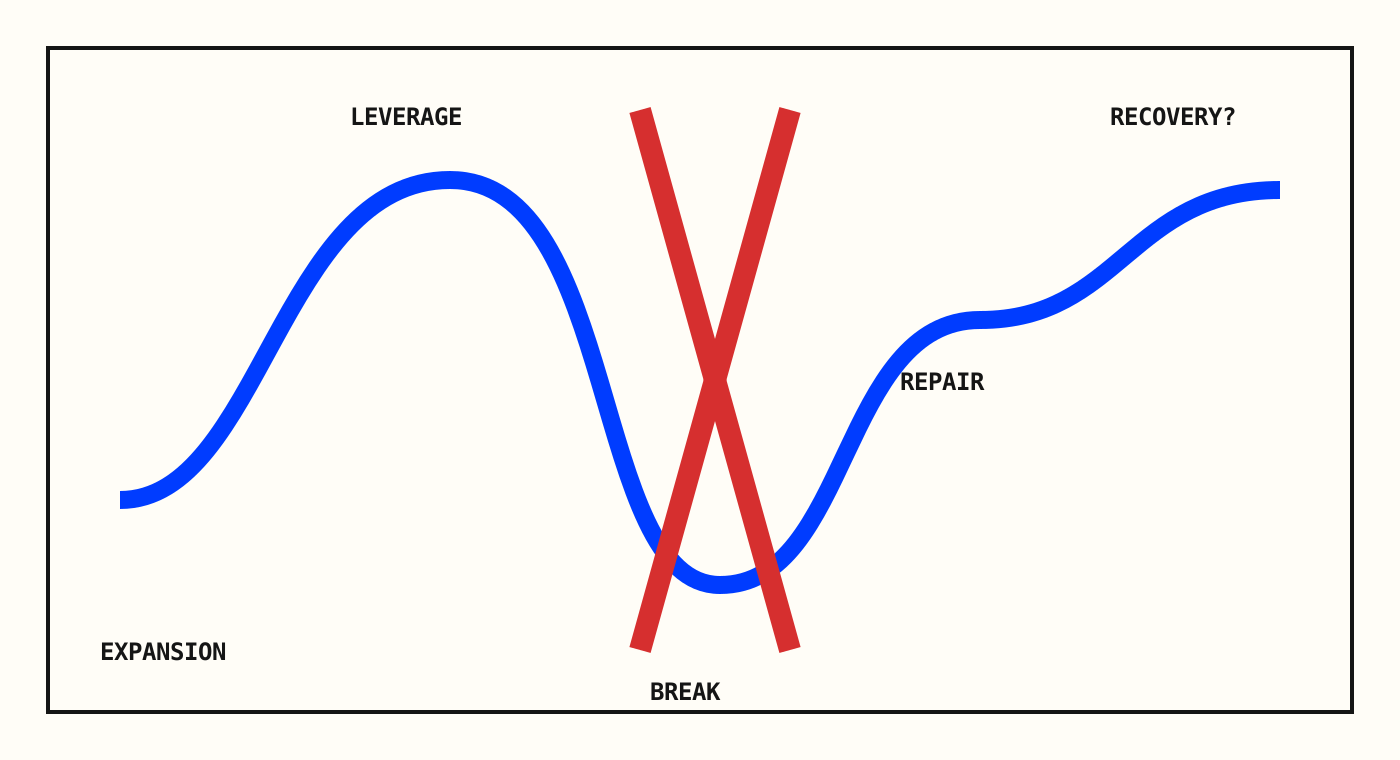
Stage 1: expansion
Expansion begins when demand, liquidity, and confidence improve. Prices rise, fundraising becomes easier, and new users tolerate complexity because the perceived opportunity is large. Healthy expansion can finance useful software, security work, infrastructure, and distribution. Unhealthy expansion can also hide costs. A project that spends more than it earns may look strong while its treasury token appreciates.
Ask what is expanding. Is it fee-paying usage, recurring revenue, secured value, active developers, or only token price and social attention? A broad increase across several independent measures is more credible than one metric amplified by incentives.
Stage 2: leverage and reflexivity
Leverage enters when participants borrow against rising assets, projects promise returns funded by token emissions, and companies assume that liquid markets will remain available. Reflexivity means rising prices improve collateral and confidence, which attracts more capital and supports further price increases. The same mechanism can reverse.
Warning signs include opaque lending, circular collateral, treasury concentration, unusually stable high yields, and business plans that require a token to appreciate. A system can appear liquid until many participants try to exit through the same narrow door.
Stage 3: the break
The break is the event that reveals an existing weakness. It might be a hack, insolvency, policy change, interest-rate shock, major liquidation, loss of a peg, or simple exhaustion of new demand. The catalyst receives attention, but the damage depends on the structure built before it.
During a break, correlation often rises. Participants sell what they can rather than only what caused the problem. Market makers reduce exposure, spreads widen, collateral falls, and forced liquidations add pressure. A technically sound network can lose value because its asset sits inside the same leveraged system.
Stage 4: repair
Repair is quieter. Weak projects shut down, companies reduce staff, token emissions change, and users demand proof instead of promises. Builders may continue even when retail attention is low. This stage is where category health becomes easier to judge because promotional noise has less support.
Look for security fixes, more conservative treasury management, transparent reserves, simpler products, lower dependence on incentives, and users who remain for a clear job. Repair is not guaranteed. Some ecosystems continue to lose developers, liquidity, and relevance until they become effectively abandoned.
Stage 5: selective recovery
A recovery is selective when capital returns to a smaller set of networks or use cases. Old leaders may not recover. New infrastructure may capture demand. A broad market label can therefore hide large differences between assets.
Past performance is especially misleading here. “It recovered last time” ignores changes in supply, competition, regulation, security, and market access. A previous high is a historical transaction, not a contractual destination.
What to measure through a cycle
| Layer | Expansion question | Downturn question |
|---|---|---|
| Users | Are new users completing a real task? | Do any remain when rewards fall? |
| Developers | Are teams shipping secure, maintained software? | Do experienced contributors continue? |
| Liquidity | Is liquidity deep or subsidised? | Can users exit without severe slippage or freezes? |
| Revenue | Who pays fees and why? | Does revenue persist without token appreciation? |
| Security | Does higher value strengthen security? | Does falling value make attacks or centralisation easier? |
Why the four-year shortcut is insufficient
Bitcoin’s issuance schedule is transparent, and halvings change the block subsidy. That matters to miners and market narratives. It does not isolate every other force affecting price. Demand, macroeconomic conditions, leverage, regulation, competition, transaction fees, and market structure can change independently.
The Bitcoin developer guide explains proof of work and difficulty adjustment as technical mechanisms. Those rules help the network target block production; they do not create a guaranteed investment cycle.
Use cycle language carefully
- Describe the phase and evidence instead of predicting a date.
- Separate Bitcoin-specific mechanics from the wider token market.
- Identify leverage and token-emission dependencies.
- Compare user activity before and after incentives.
- Assume that some projects will not participate in any recovery.
- Record the source date for volatile market claims.
Sources and limits
Current market reporting can establish that prices and capital flows changed, but it cannot prove a fixed cycle. Reuters reported substantial 2026 Bitcoin weakness and movement toward other investment themes; read the June 2026 Reuters market report for that dated context. For risk discipline, the CFTC advisory on virtual currency trading explains volatility, platform safeguards, cyber risk, and manipulation concerns.
Return to the crypto health diagnostic, visit the field guide index, or continue with how to evaluate a crypto project.