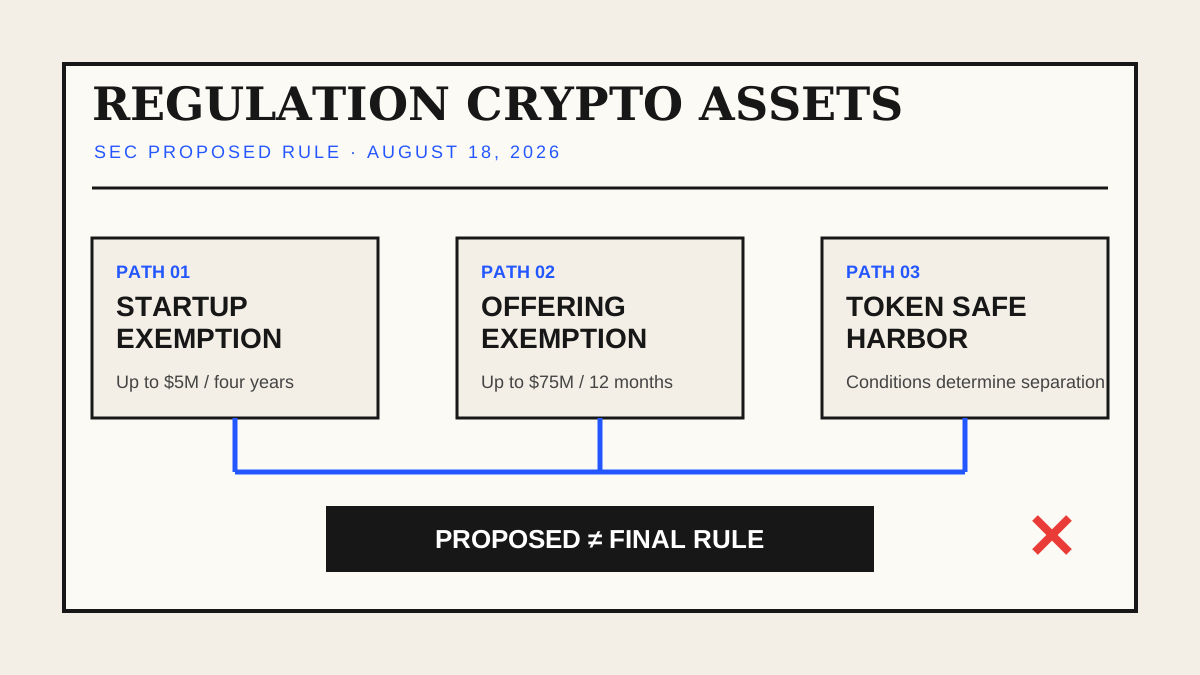
On August 18, 2026, the U.S. Securities and Exchange Commission proposed Regulation Crypto Assets, a framework that would create tailored exemptions for some crypto fundraising and a safe harbor that could allow certain crypto assets to cease being treated as subject to an investment contract when specified conditions are met. It is a proposed rule, not a final rule. Companies cannot assume that the exemptions are available merely because the proposal has been published.
What is confirmed
The SEC published proposed Release No. 33-11434, File No. S7-2026-27, titled Regulation Crypto Assets. The proposal describes three distinct regulatory pathways rather than one blanket exemption: a startup exemption for smaller offerings, a larger offering exemption with disclosure and reporting conditions, and a crypto-asset safe harbor tied to the end of the investment-contract relationship. Reuters independently reported the proposal on August 18 and described the same core structure.
The SEC document is the controlling source for the proposal's text. The current release also shows that the public-comment deadline is tied to publication in the Federal Register; the issued PDF still contains placeholder language for that Federal Register date. That means a fixed comment deadline should not be invented until the Federal Register publication date is confirmed.
The startup exemption
The proposed startup exemption is designed for relatively small crypto offerings. Under the SEC proposal, an eligible issuer could raise up to $5 million during a four-year period without using a traditional Securities Act registration statement, subject to conditions including notices and disclosures. The four-year period is intended as a development runway rather than a permanent exemption from securities-law obligations.
The important analytical point is scope. A $5 million ceiling does not mean every token project raising less than that amount automatically qualifies. Eligibility, disclosure, anti-fraud obligations and the exact transaction structure still matter. Readers evaluating a project should ask which exemption the issuer says it relies on and whether the required filings and disclosures actually exist.
The larger offering exemption
The proposal also describes a pathway for offerings of up to $75 million in a 12-month period. This is materially larger than the startup exemption and comes with a more developed disclosure framework. Reuters highlighted the $75 million annual ceiling when reporting the proposal.
For investors, the useful distinction is between an exemption from full registration and an exemption from all oversight. They are not the same. A tailored exemption can reduce registration burden while preserving disclosure, reporting and anti-fraud requirements. Marketing language such as “SEC exempt” should therefore be treated as incomplete unless it identifies the exact exemption and conditions.
What the token safe harbor is trying to solve
The safe-harbor portion addresses a recurring problem in U.S. crypto regulation: a crypto asset may be sold as part of an investment contract even if the asset itself is not inherently a security. The proposal builds on the SEC's March 2026 interpretation, which distinguished several categories of crypto assets from the contractual promises that can make a transaction an investment contract.
Under the proposed framework, a crypto asset could be deemed no longer subject to an investment contract for federal securities-law definitions when the safe-harbor conditions are satisfied. This is not a declaration that every decentralized token eventually becomes a non-security. The issuer or project would need to meet the rule's specific requirements.
| Proposed pathway | Headline limit or purpose | What it does not mean |
|---|---|---|
| Startup exemption | Up to $5 million over a four-year period | Not automatic eligibility for every small token sale |
| Offering exemption | Up to $75 million in a 12-month period | Not freedom from disclosure or anti-fraud rules |
| Token safe harbor | Path for an asset to cease being tied to an investment contract when conditions are met | Not a blanket declaration that crypto assets are securities or non-securities |
Why the proposal matters for project evaluation
For years, project teams and investors often relied on vague claims that a network would “decentralize later.” A rule-based safe harbor could make that transition more testable by connecting legal treatment to specified representations, disclosures and completion of essential managerial efforts. That can improve the evidence available to users, but only if the final rule preserves objective conditions and issuers comply with them.
For due diligence, regulatory structure should be added to the ordinary project review rather than replacing it. A project can satisfy a securities-law exemption and still have weak token economics, concentrated governance, insecure smart contracts or poor liquidity. The Bitdova project-evaluation framework remains relevant because legal status is only one layer of project quality.
What remains unresolved
- The proposal is not final and can change after public comment.
- The final Federal Register publication date and resulting comment deadline must be confirmed from the Federal Register rather than guessed from the SEC PDF placeholder.
- Eligibility depends on the detailed conditions in the rule, not only the dollar thresholds.
- A future final rule could be challenged, amended or superseded by legislation.
- The proposal does not resolve every question involving exchanges, custody, broker-dealer activity, commodities regulation or state law.
How to verify a project's claim
- Ask for the exact SEC exemption or safe-harbor provision the issuer says it is using.
- Check the SEC filing, notice or disclosure rather than relying on a press release.
- Confirm the offering amount, time period and issuer identity.
- Separate the legal treatment of the fundraising transaction from the technical characteristics of the token.
- Review governance, unlocks, custody, liquidity and security independently.
- Re-check the rule status before treating any proposed provision as effective law.
Primary and independent sources
The primary source is the SEC's August 18 proposed rule, Release No. 33-11434. For the policy background, see Chairman Paul Atkins' March 17 remarks outlining the safe-harbor concept and the SEC's March 2026 crypto-asset interpretation. Reuters independently reported the August 18 proposal and its $5 million and $75 million pathways in its coverage of the rulemaking.
Continue the field research
Use the crypto risk-signals checklist to test promotional claims, compare the proposal against the broader market-cycle framework, or return to the field-guide index. Regulatory clarity can change how a project raises money; it does not by itself prove that the project is useful, solvent or secure.